Where a Moving Truck Can Park on Moving Day in North York
The City of Toronto parking exclusions, Street Occupation Permit scope and building access rules that decide where a truck can stop on a North York moving day.
Toronto offers no parking exemption for moving day
A loaded truck at a North York curb while the crew waits for a space gets no special treatment for a moving day, because Toronto's Special Parking Consideration is not available for moving days.
The same City page also names specific curb locations where Special Parking Consideration never applies, whatever the reason for the request. Because of that, a moving truck answers to the posted signs on the block like any other vehicle, and neither the size of the load nor the length of the job earns it extra tolerance from enforcement.
Plenty of residents expect a quick call to the City to cover a few hours of curb use, yet the explicit exclusion of moving days means that call produces no exemption at all. The legal parking space has to be identified before the truck leaves the origin address, since the City offers no fallback once the vehicle has arrived and the crew is ready to unload.
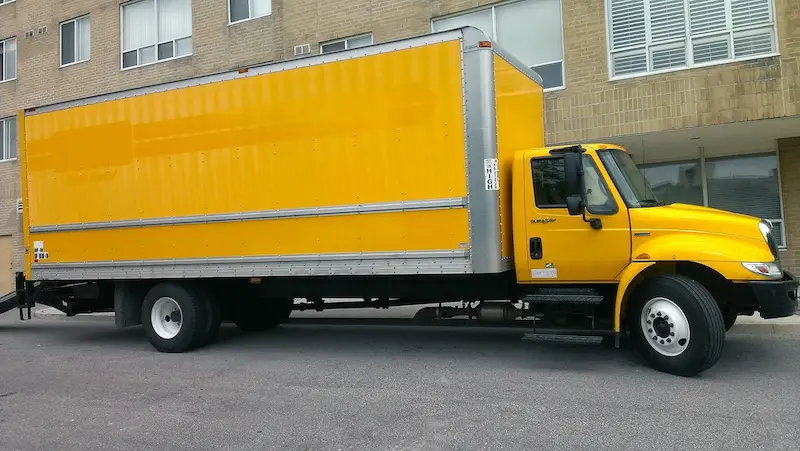
Toronto's parking leniency program excludes moving days, so this truck follows the posted signs like any other vehicle.
Curb spaces a moving truck cannot use
Pulling the truck onto the boulevard or sidewalk in front of a house to shorten the carry is a common curb mistake, and the City lists sidewalks and boulevards among the places Special Parking Consideration never covers. Equipment such as a bin or container left on those surfaces falls under a separate City permit, set out in the next section.
Fire routes and No Stopping or No Standing zones sit on the same exclusion list. These designations often front apartment and condo entrances, which means a truck cannot hold the space outside the lobby doors on the strength of a moving booking alone. Any arrangement that lets the crew load at the entrance has to come from the building itself, through its own loading area and property management.
Permit parking streets reserve their curbs for permit holders, and the City excludes them from Special Parking Consideration too. On those blocks the nearest legal space may sit well down the street, and every extra metre between the truck and the door turns into crew time. That matters most on hourly jobs such as apartment moving, where the rate runs from arrival to completion.
When a street occupation permit applies
Toronto requires a Street Occupation Permit to temporarily occupy the boulevard, sidewalk, roadway or public lane beyond the property line with equipment such as a disposal bin in the roadway or laneway, or a moving container, during a demolition, renovation or construction project. A bin kept on the driveway stays inside the property line, the boundary the City uses for this permit. Once it crosses onto the roadway or laneway, the City charges the fee per day, with separate charges for each additional lane closure or for a full lane closure, so every day the container stays out adds to the cost.
Permits must be obtained in person and paid for when they are issued, according to the City's permit page. That in-person step puts the application in the days before the move, since a container dropped on the roadway before the permit exists occupies public space without one.
Loading areas, elevators and insurance certificates
In a North York apartment or condo, the truck's spot usually depends on the building's loading area and service elevator, since the fire routes and No Stopping or No Standing zones that often front lobby doors are excluded from the City's parking leniency. Move Your Stuff's apartment page names elevator access as the binding constraint for same-day moves.
Some buildings ask for a certificate of insurance before the crew can use the loading area or elevator, and Move Your Stuff provides certificates of insurance to building management on request, typically within 24 to 48 hours. For commercial buildings, the company's office moving page states that it carries commercial coverage and supplies a COI meeting standard commercial landlord requirements.
Booking the shortest elevator slot to save time backfires once the unit needs more hours than the slot allows, and the published crew sizes show how quickly that happens. A bachelor apartment typically takes a two-person crew two to four hours, a one-bedroom needs two to three movers over three to five hours, and a two-bedroom generally requires a three-person crew and a full elevator window.
The hourly apartment rate covers the crew and truck from arrival to completion, including elevator time, protection setup, and disassembly and reassembly. The written estimate rests on unit size, floor level, elevator access and distance, so a parking space down the block or an elevator window that runs short shows up directly in the hours billed.
In a tower, the loading area and the booked elevator window decide where the truck waits, more than the street does.
Lead times that secure a legal spot
Move Your Stuff recommends booking an apartment move at least two weeks in advance, which leaves room to line up the elevator booking and the certificate of insurance, though shorter notice is possible depending on schedule availability. Office relocations carry longer published lead times that scale with headcount: two to three weeks for offices under 10 people, four to six weeks for medium and large moves, and six to eight weeks for 50 or more people.
After-hours and weekend office moves are standard, which brings the truck to a commercial building outside its busiest hours, and phased office moves are available for offices of 20 or more people. A phased move uses more than one loading window, so each one needs its own confirmed access arrangement with the landlord.
Ask building management at both addresses for the loading area rules, the elevator window and the name the COI must list, then check the signs in front of each address for No Stopping zones, fire routes and permit parking. Call Move Your Stuff at 647-982-1819, 9 a.m. to 9 p.m., 7 days a week, or use the quote page; local details sit on the North York residential moving page. The certificate is typically provided within 24 to 48 hours of the request, so the request belongs well before moving day.
When a North York bin or moving container needs a Toronto Street Occupation Permit, what drives the permit fee, the moving day parking exclusion, and city drop-off depots.